
Collection Record
Identification
Collection Number: DS-19C-DB02
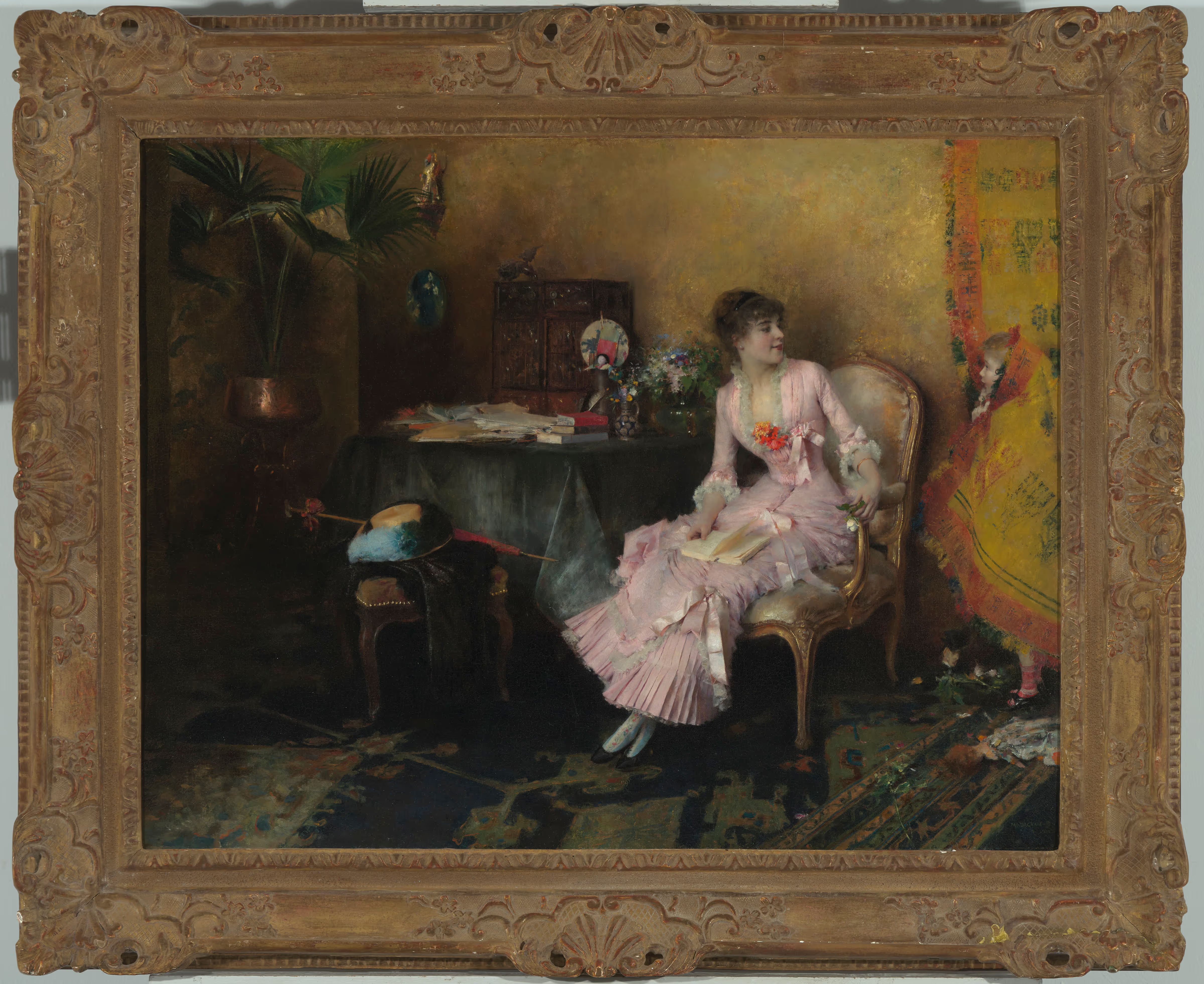
Current Title: Cache-Cache (Hide and Seek)
Former / Historical Title: Jeune femme en rose avec son enfant (1930)
Date: 1882
Century: 19th Century
Artist / Attribution
Artist: PASCAL ADOLPHE JEAN DAGNAN-BOUVERET
Born date: 7 January 1852, Ancien 3e arrondissement de Paris, France
Died date: 3 July 1929 (aged 77), Quincey, France
Attribution: fully attributed to PASCAL ADOLPHE JEAN DAGNAN-BOUVERET
School / Culture: French School
Movement: Academism/Naturalism
Materials and Techniques
Medium: Oil on canvas (relined)
Support: Canvas-relined
Object Type: Painting
Dimensions: 62.9 by 80.6 cm (24¾ by 31¾ in.)
Inscriptions: Signed P-A-J-DAGNAN-B, indistinctly inscribed PARIS, and dated 1882 (lower right)
Markings: No markings recorded
Collection Information
Department: Paintings
Classification: Oil painting
Acquisition Date: 30 April 2026
Acquisition Source: Shannon’s LLC
Acquisition Context: Acquired by DESSINART in 2026 as part of its ongoing research into nineteenth-century French painting.
Conservation Status: Condition assessment pending
Research Records
Provenance: The artist; Goupil & Cie, Paris, France, 1882 (no. 16193); Knoedler & Co, New York, 1883; Charles Goddard Weld, Boston, Massachusetts; Hammer Galleries, New York, 1940; Private Collection, Massachusetts; Thomas Colville Fine Art, Guilford, Connecticut and New York, New York; Private Collection, New York
Exhibition: Exhibition history under research.
Literature: Jean Dampt and André-Charles Coppier, Catalogue des œuvres de M. Dagnan-Bouveret. Peintures, Paris, Librairie du Bulletin de l’Académie des Beaux-Arts / Maurice Rousseau, 1930, p. 23, as Jeune femme en rose avec son enfant.
Archival Records: Archival records under research.
Archival Records
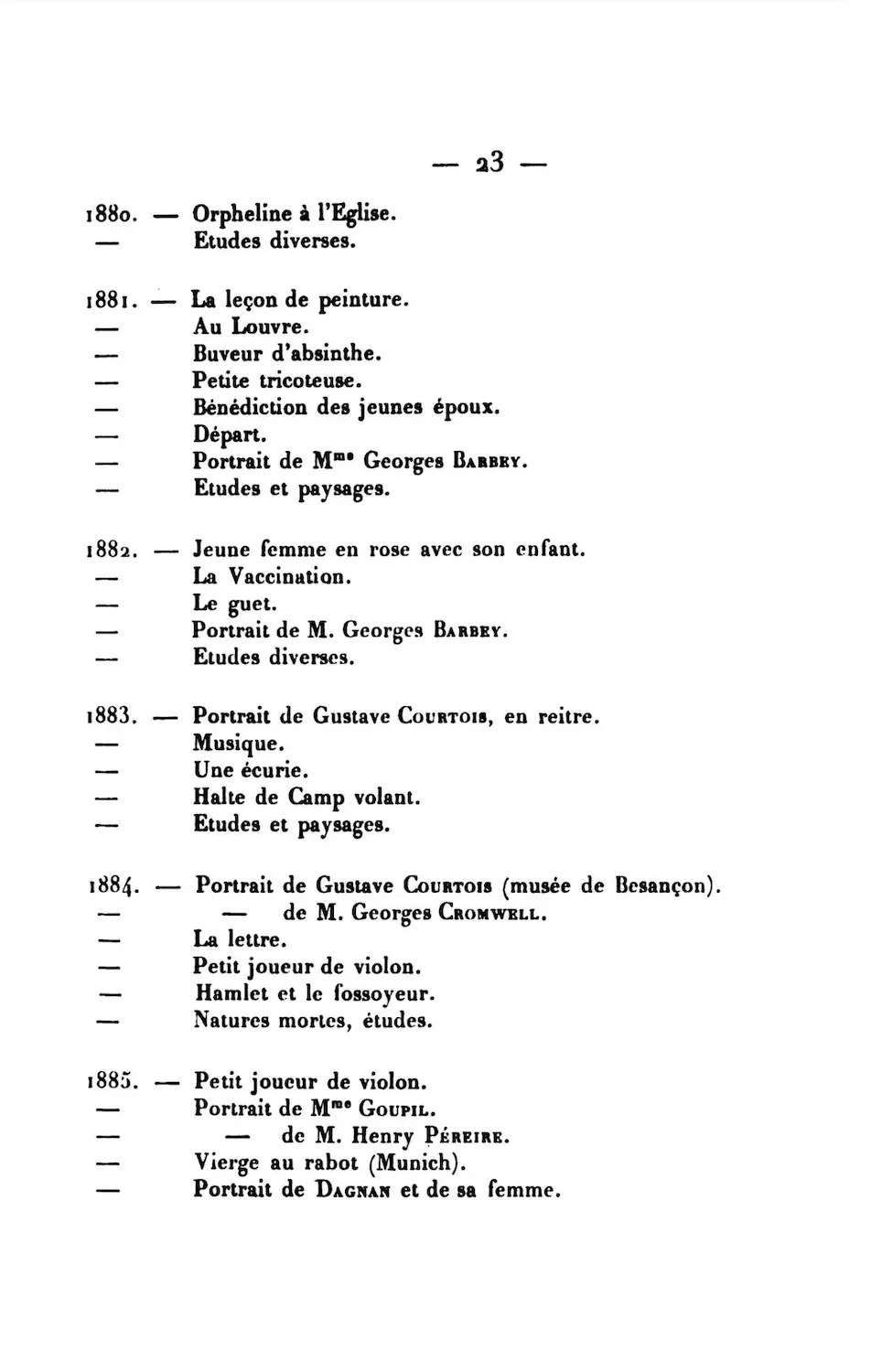
Jean Dampt and André-Charles Coppier, Catalogue des œuvres de M. Dagnan-Bouveret. Peintures, Paris, Librairie du Bulletin de l’Académie des Beaux-Arts / Maurice Rousseau, 1930, p. 23, as Jeune femme en rose avec son enfant.
Related Works
Essay by the Former Collector
In the early 1880s, Dagnan-Bouveret turned his attention away from traditional Salon subjects and instead focused on scenes from contemporary society as popularized by the novels of Emile Zola and Alphonse Daudet. Dagnan-Bouveret's genre scenes found a ready market in Europe and especially in America and Cache-Cache was the sort of painting that had immense appeal. As a dedicated chronicler of both modern and fashionable Paris, Dagnan-Bouveret's paintings from the early 1880s often depict scenes set in well-appointed Paris interiors. These settings, with their abundance of objects, made with varied textures and colors, allowed him to showcase his technical virtuosity learned earlier in the studio of Jean-Léon Gérôme.
Cache-Cache is a snapshot of its time and represents an inside view of upper-class life in the last decades of the 19th century in Paris. Dagnan-Bouveret abandoned subjects like this after the early 1880s. He replaced it with themes from peasant life in the spirit of Jules Bastien Lepage and, later, an almost mystical interpretation of scenes from the life of Christ and the Blessed Virgin Mary.
In this painting, the two models play a game of hide-and-seek. The unposed casualness of the scene - almost like a snapshot - suggests Dagnan-Bouveret's early explorations into the use of photography and how it could be translated into painting. Of equal importance to the two figures is the opulent interior of the room with all of its fittings; the space overflows with decorative details, silk and velvet fabrics, a copper pot, an oriental rug and a gilt chair. Through the various objects on the table and mounted on the wall, the painting also illustrates Dagnan-Bouveret's fascination with Japanese and exotic knick-knacks, a passion he shared with James McNeill Whistler, and many of his contemporaries, like Alfred Stevens and Claud Monet. In fact, Japonism became an integral part of upper-class interiors after Japanese ports reopened to Western trade in 1854 following 200 years of closure. The world fairs in London in 1862 and in Paris in 1867, where Japan showed its art and objects for the first time, were especially instrumental in developing the vogue for all things Japanese.
Interestingly, the first private owner of Cache-Cache was the Boston collector, Charles Goodard Weld (1857-1911). In 1886, Weld purchased the esteemed Ernest Francisco Fenollosa collection of Japanese art, bequeathing it together with his own personal holdings of Japanese art to the Museum of Fine Arts in Boston. This generous gift contributed to the museum becoming known for the most extensive collection of Japanese art outside of Japan.
Dagnan-Bouveret bridged the gap between Academic painting and emerging modern themes. His paintings often foreshadow Symbolism and are seen as pivotal in the historical shift away from rigid academic styles. In 2002, an exhibition of his works at the Dahesh Museum of Art titled "Against the Modern: Dagnan-Bouveret and the Transformation of the Academic Tradition", focused on this aspect of his artistic legacy.
Essay by Dr. Gabriel P. Weisberg
Long unrecorded and recently rediscovered, Jeune femme en rose avec son enfant offers new insight into Pascal Adolphe Jean Dagnan-Bouveret's early career. The paintings of the late 1870s and early 1880s of well-appointed interiors, like Courtois in his studio (1881, sold in these rooms May 5, 2011, lot 41, fig. 1) and Petit Concert (1883), reflected the lifestyle and taste of Dagnan-Bouveret's early patrons. While the young woman and child depicted in the present work are unknown, it was completed the same year as the artist’s 1882 Salon submission Portrait of Mme. G. … B…… (Catalogue Illustré du Salon, 1882, no. 699), depicting the wife of Georges Barbey, a wealthy proprietor from the small village of Corre in the Franche Comté. The increasing number of commissioned portraits (which had previously focused on his immediate family) and the accolades and income received from them positioned Dagnan-Bouveret well through the following phase of his career as he became the standard bearer of Salon naturalism.
Dagnan-Bouveret's characteristic wit and careful eye for detail are on display in Jeune femme en rose avec son enfant, depicting an elegantly dressed young mother in a plush, gilded chair, her open book one of many set on the table beside her. A myriad of objects on the table and mounted on the wall behind reflect the contemporary vogue of japonisme and the cultivated worldliness of the artist himself. A set aside hat and closed parasol suggest the young woman has just returned to her book or perhaps is about to leave, either scenario interrupted by a child playfully using a decorative carpet as a shawl. The pose is reminiscent of his close friend Jules Bastien-Lepage’s Pauvre Fauvette (1881, Glasgow Museums, fig. 2) and well-known to contemporary audiences through its inclusion at the 1882 Royal Academy exhibition, suggesting a subtle commentary by the artist on the popularity of French realist and naturalist painters of peasants among affluent audiences.
Kindly confirming the authenticity and providing the Essay entry for this painting by Dr. Gabriel P. Weisberg (Professor Emeritus at the University of Minnesota)
Condition
The following condition report was kindly provided by Simon Parkes Art Conservation, Inc.: This work is restored. The canvas has an old glue lining. The surface is quite dull. Although it may not need to be cleaned, it seems the varnish could be effectively brightened. The figure is in beautiful condition, showing no retouches. The figure of the child on the far right is also beautifully preserved. Retouches have been added in the darkest colors around the seated figure's feet, around the hat on the stool on the left side, and beneath the plant on the far left to address some cracking. These retouches are well applied. If the varnish were adjusted, the work could be hung as is.
BIOGRAPHY - Pascal-Adolphe-Jean Dagnan-Bouveret
Pascal-Adolphe-Jean Dagnan-Bouveret’s career began with his admission to the Ecole des Beaux-Arts in April 1869 where he initially worked in the studio of Alexandre Cabanel. Like all young Frenchmen at the time, his career was temporarily derailed by the Franco-Prussian War and the Paris Commune of 1870-71, but he resumed his education in 1872, settling comfortably into the studio of Jean-Léon Gérôme. In 1875, Dagnan-Bouveret debuted at the Salon with a depiction of the triumphant Atalanta, the Greek heroine who bested all her male competitors in a footrace.
In addition to the standard Beaux-Arts curriculum in Gérôme’s studio, Dagnan-Bouveret also learned how to use photography as a tool, both for organizing a composition and for keeping a record of potentially useful visual images. Although photography was still a fledgling technique in the 1870s, it would become a crucial tool for many artists later in the century. Many of Dagnan-Bouveret’s paintings reveal the use of thoughtfully posed photographs, combined with traditional compositional sketches in ink or pencil, as the basis for the finished work.[i] In fact, key paintings such as Horses at the Watering Trough, 1884, or The Pardon in Brittany, 1886, were painstakingly developed through preparatory photographs and drawings that were ultimately transferred onto the final canvas.
Dagnan-Bouveret’s work also reveals a carefully crafted fusion of classical academic training with subject matter that is based on the everyday life of ordinary people. As a young artist in 1870s Paris, he was undoubtedly aware of Realist painters such as Gustave Courbet or François Bonvin, but the Dutch genre tradition of illustrating domestic scenes and rural life may have been equally influential. The 1879 painting entitled The Accident, for example, is set in a modest rural interior where a young boy sits anxiously on a chair while a doctor wraps his wounded arm. Unpretentious copper pitchers and pots gleam on the mantel above a massive hearth, while the extended family gathers around a trestle table to watch the medical procedure. Their ragged clothes are a marked contrast to the more fashionable—and prosperous—suit that the doctor wears. This type of narrative painting is immediately clear to any viewer regardless of educational background; understanding the story does not depend on knowledge of classical Greek and Roman literature.
Similarly, Dagnan-Bouveret embraced the Realist dictum to paint ‘modern life’. In the ink drawing of A Bird Charmer in the Tuileries Gardens, 1879, he created a beguiling image of contemporary Parisian street life. A year later, in The Laundress, he inserts himself and his close friend Gustave Courtois into an enigmatic scene of a weary young laundress seated on a park bench. As she rests from her labors, the distinctive figures of Dagnan-Bouveret and Courtois stroll through the autumn cityscape, seemingly oblivious to the attractive young woman. In both of these images, the artist rejects sentimental commentary, refusing to impose any interpretation, but instead asking the viewer to determine the meaning.
With his career firmly launched by the late 1870s, Dagnan-Bouveret turned his attention to more personal matters when he married Courtois’ cousin, Anne-Marie, in 1879. The couple met during the artist’s numerous visits to his friend’s home in the Franch-Comté, and it was to this region that Dagnan-Bouveret would return repeatedly in the decades to come. Anne-Marie’s influence on her husband’s work is especially evident in the religious images that begin to appear in the 1880s and eventually become the primary theme of his work.
Throughout the 1880s and 1890s, Dagnan-Bouveret developed a very successful career in a variety of genres; he continued to create naturalist images of daily life, both urban and rural, and increasingly focusing on religious painting. In 1886, he began a series of paintings on the theme of the Breton custom of the “pardon”, an annual pilgrimage associated with the feast day of the patron saint of a local church. Clothed in traditional Breton costumes, pilgrims would gather on the eve of the feast day for confession, and then rise for early morning mass and a day of prayer. Following the worship services, they walked in procession around the church where others who wished to offer prayers of gratitude could join in, often carrying objects such as crutches that were no longer needed. This unique combination of theatricality, unsullied rural custom, and Christian piety were appealing not only to Dagnan-Bouveret, but also to the countless other artists who would travel to Brittany in the closing years of the nineteenth century.
The series of paintings on the Brittany pardons also opened the door for Dagnan-Bouveret’s exploration of other religious subjects. In the late 1880s, he began creating paintings of the Madonna, using the Renaissance example of Raphael as inspiration, but transforming the image into a contemporary Symbolist meditation. The Consolatrix Afflictorium (The Consoling Madonna) of 1899 depicts a mystically lit forest where the Madonna and Child, surrounded by angels, offer divine comfort to a kneeling man. This message of solace found a ready buyer in the American art collector Henry Clay Frick, who had recently lost his young son.[ii]
At the Exposition Universelle of 1900, Dagnan-Bouveret’s status as a respected artistic leader enabled him to showcase his paintings, including The Lord’s Last Supper, in a separate installation on the fairgrounds. The size of this work, at nearly 10 x 18 feet, was intended to create a sense of immediacy, as if the viewer were a witness to the crucial Thursday evening meal. As with his Madonna paintings, Dagnan-Bouveret based the composition of The Lord’s Last Supper on Renaissance models, but the mystical lighting spotlights very contemporary French faces on the apostles.
In November of 1900, Dagnan-Bouveret’s was elected to the Académie des Beaux-Arts of the Institut de France, one of the youngest painters to ever receive this honor. Although often overwhelmed by the swift developments of modernism in the opening decades of the twentieth century, he continued to paint religious images as well as portraits until his death in 1929. In the twenty-first century, his work has been reevaluated—and celebrated—with a 2002 exhibition sponsored by the Dahesh Museum in New York
By Janet Whitmore, Ph.D.
[i] For a discussion of Dagnan-Bouveret’s extensive use of photography, see Gabriel P. Weisberg, Against the Modern: Dagnan-Bouveret and the Transformation of the Academic Tradition, (New Brunswick, New Jersey and London: Rutgers University Press, 2002).
[ii] Ibid 114-116.
Awards
Société des Artistes Françaises, Paris
1878: Third Class medal for Manon Lescaut
1880: First class medal for The Accident
1885: Medal of Honor for Horses at the Watering Trough
1889: Grand Prize for Breton Women at a Pardon
Museum collections
Art Institute of Chicago
Bayerische Staatsgemälde-sammlungen, Munich
Carnegie Museum of Art, Pittsburgh
Chrysler Museum of Art, Norfolk, Virginia
Ecole Nationale Supérieure des Beaux-Arts, Paris
Hermitage Museum, St. Petersburg
Metropolitan Museum of Art
Montreal Museum of Fine Arts
Musée des Beaux-Arts, Arras
Musée des Beaux-Arts, Lyon
Musée Georges Garret, Vesoul
Musée Municipale, Melun
Museum of Fine Arts, Boston
Philadelphia Museum of Art
Pushkin Museum of Fine Arts, Moscow
Pyms Gallery, London
Walters Art Museum, Baltimore